
Continuous Testing Market to Reach USD 3.09 Billion by 2031 as Cloud Deployment and Automated Software Testing Gain Ground
[Hyderabad/India] – October 21, 2026 – Continuous Testing Market Overview and Outlook
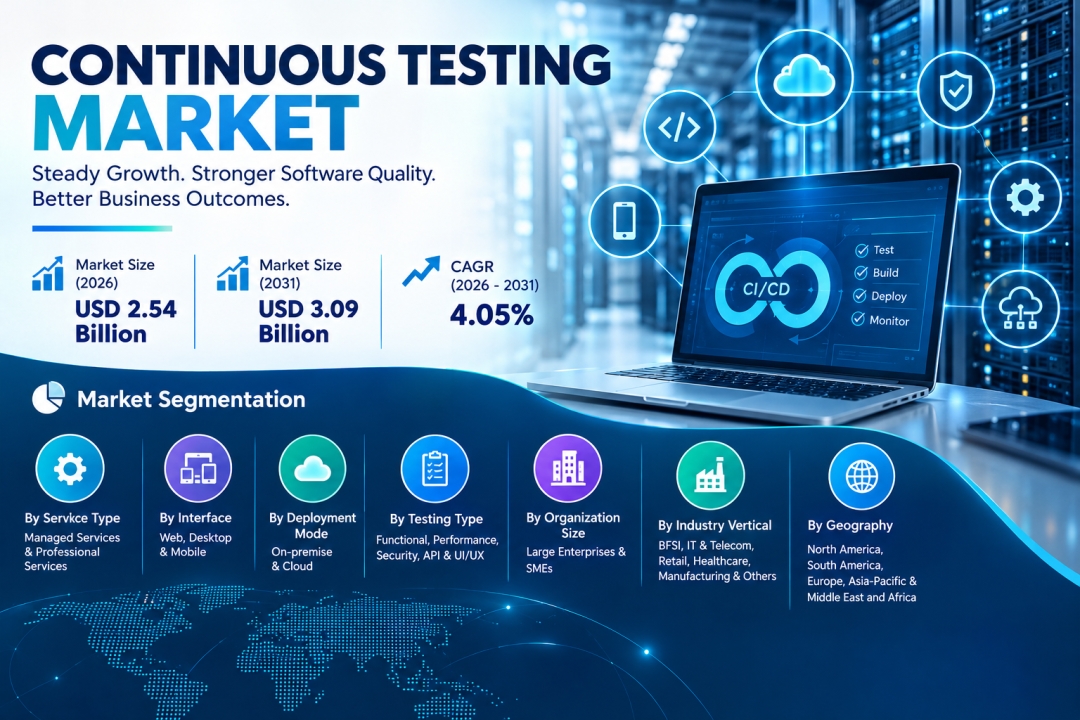
The Continuous testing market size is estimated to grow from USD 2.54 billion in 2026 to USD 3.09 billion by 2031, registering a CAGR of 4.05% during the forecast period. Continuous testing enables organizations to assess software quality throughout the development lifecycle by integrating automated tests into continuous integration and continuous delivery workflows. Businesses use these practices to identify defects earlier, reduce manual testing workloads, and maintain software reliability as applications undergo frequent updates. The approach supports development teams seeking consistent releases while managing quality requirements across complex applications and digital services.
The Continuous testing industry serves organizations across banking, financial services and insurance (BFSI), information technology, telecommunications, retail, healthcare, manufacturing, and other sectors. Demand is influenced by the need for dependable applications, shorter development cycles, and broader cloud adoption. Organizations are incorporating functional, performance, security, and application programming interface (API) testing into their software delivery processes. The Continuous testing market trends also reflect the use of web, desktop, and mobile testing solutions, alongside managed and professional services that help businesses address testing requirements across different deployment environments.
Key Trends in the Continuous Testing Market
Growing Adoption of Cloud-Based Testing Environments
Cloud deployment gives organizations flexible access to testing infrastructure without requiring the same level of investment in on-premise resources. Development teams can run tests across multiple environments, coordinate distributed projects, and adjust testing capacity as requirements change. These capabilities support organizations managing frequent software releases and applications used across different devices. Cloud-based testing also helps businesses integrate testing activities into established development workflows, while on-premise environments remain relevant for organizations with specific infrastructure, security, or compliance requirements.
Rising Demand for Automated Functional and API Testing
Organizations are incorporating automated functional testing and API testing to verify application behavior as software components change. Functional testing checks whether applications meet defined requirements, while API testing evaluates communication between software services. Integrating these tests into development pipelines helps teams identify defects before updates reach production environments. As applications become more interconnected, consistent testing across interfaces and services remains important for maintaining reliability. These requirements contribute to Continuous testing market growth by encouraging businesses to expand automated test coverage across their software portfolios.
Increasing Focus on Performance, Load, and Security Testing
Application performance and security remain important considerations for organizations operating customer-facing platforms and business-critical systems. Performance and load testing help teams assess application behavior under different traffic conditions, while security testing identifies potential vulnerabilities before deployment. Businesses in financial services, healthcare, retail, and telecommunications require dependable applications to support transactions and sensitive information. Integrating these testing activities into regular development cycles enables earlier identification of performance bottlenecks and security weaknesses, reducing the risk of issues emerging after software releases.
Expanding Use of Managed and Professional Testing Services
Managed services and professional services support organizations that need specialized testing expertise, implementation assistance, or additional delivery capacity. Managed services can help businesses maintain ongoing testing operations, while professional services assist with test strategy, automation implementation, and process improvements. Large enterprises may use external specialists to coordinate testing across complex applications, whereas small and medium enterprises can seek support for capabilities that are difficult to maintain internally. These service models influence Continuous testing market share by shaping how providers address different customer requirements and organizational resources.
Check out more details and stay updated with the latest industry trends, including the Japanese version for localized insights:
Continuous Testing Market Segmentation
The market is segmented by service type, interface, deployment mode, testing type, organization size, industry vertical, and geography.
-
By Service Type: Managed Services and Professional Services.
-
By Interface: Web, Desktop, and Mobile.
-
By Deployment Mode: On-premise and Cloud.
-
By Testing Type: Functional Testing, Performance and Load Testing, Security Testing, API Testing, and UI/UX Testing.
-
By Organization Size: Large Enterprises and Small and Medium Enterprises.
-
By Industry Vertical: BFSI, IT and Telecom, Retail and eCommerce, Healthcare and Life Sciences, Manufacturing, Media and Entertainment, and Others.
-
By Geography: North America, South America, Europe, Asia-Pacific, and the Middle East and Africa, including the United States, Canada, Mexico, Brazil, Argentina, Germany, the United Kingdom, France, Italy, Spain, Russia, China, India, Japan, South Korea, Australia, Saudi Arabia, the United Arab Emirates, Turkey, South Africa, Nigeria, and other regional markets.
Explore Our Full Library of Technology Media and Telecom Research:
https://www.mordorintelligence.com/market-analysis/technology-media-and-telecom?utm_source=abnewswire
Key Players in the Continuous Testing Market
The Continuous testing market includes technology providers offering software development, testing, automation, and enterprise IT solutions. Key companies identified in the competitive landscape include Mindtree Limited, EPAM Systems Inc., Broadcom Inc. (CA Technology, Inc.), IBM Corporation, and HCL Technologies Ltd. These companies participate in the broader software engineering and testing services ecosystem, serving organizations with different application environments and development requirements.
Competition is influenced by service capabilities, automation expertise, enterprise integration, deployment flexibility, and the ability to support testing across multiple application types. Buyers evaluate providers based on their existing technology infrastructure, internal skills, software delivery schedules, and testing objectives. The competitive landscape reflects demand for solutions that fit established development processes while helping organizations maintain software quality and release consistency.
Explore more insights on the Continuous Testing competitive landscape:
Conclusion
The Continuous testing market forecast reflects continued demand for software quality assurance as organizations maintain applications across cloud and on-premise environments. Automated functional testing, API validation, performance assessment, and security testing remain important components of software delivery processes. Organizations are also considering managed and professional services to address testing capacity and expertise requirements.
As businesses across financial services, IT and telecommunications, retail, healthcare, and manufacturing continue to maintain digital applications, testing providers have opportunities to address diverse operational needs. The market outlook will depend on organizations’ software development priorities, automation adoption, deployment preferences, and requirements for reliable application performance. Understanding these factors can help technology buyers and service providers assess opportunities across the Continuous testing industry.
About Mordor Intelligence:
Mordor Intelligence is a global market intelligence firm, founded in 2014, helping businesses make informed decisions through data-driven insights, industry expertise, and advanced analytics. With 550+ domain experts and on-ground specialists across 150+ countries, the company delivers comprehensive intelligence across aerospace & defense, agriculture, automation, automotive, chemicals & materials, consumer goods & services, electronics, energy & power, financial services, food & beverages, healthcare, hospitality & tourism, information & communications technology, and logistics.
Its offerings include syndicated industry reports, custom research and advisory, and subscription platforms such as Synapse, Data Center Intelligence, andRobotics Intelligence. Mordor Intelligence is ISO 9001:2015 and ISO/IEC 27001:2022 certified, a member of ESOMAR and the Market Research Society of India, and a four-time Great Place to Work® honoree.
Media Contact
Company Name: Mordor Intelligence Private Limited
Contact Person: Jignesh Thakkar
Email: Send Email
Phone: +1 617-765-2493
Address:11th Floor, Rajapushpa Summit, Nanakramguda Rd, Financial District, Gachibowli
City: Hyderabad
State: Telangana 500008
Country: India
Website: https://www.mordorintelligence.com/


