
Ewing Sarcoma Market Size in the 7MM is projected to grow at a CAGR of 11.7% over the forecast period of 2026-2036 | DelveInsight
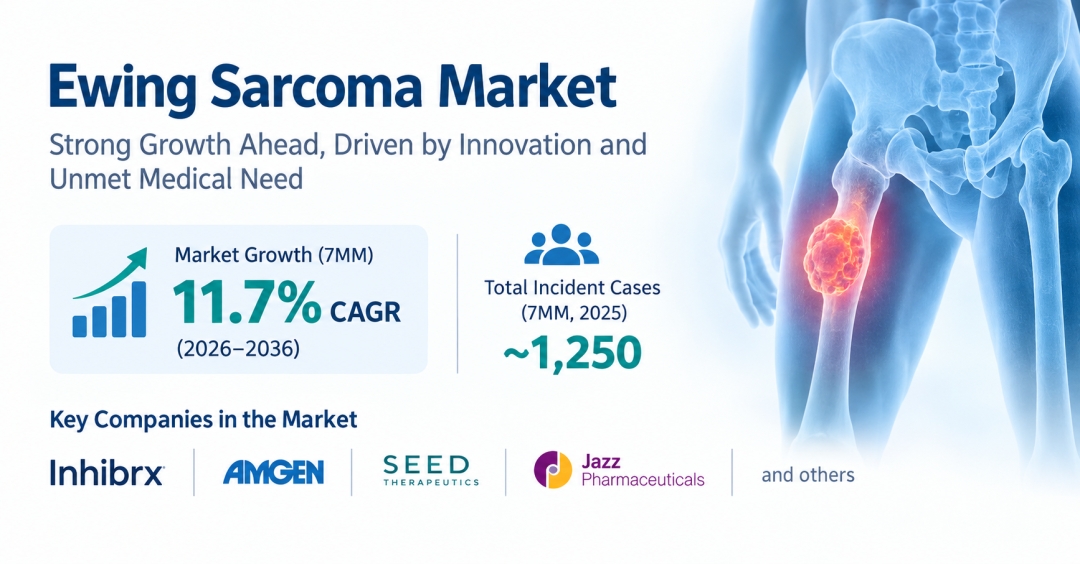
(Albany, US), October 27, 2026 – DelveInsight’s ‘Ewing Sarcoma Market Insights, Epidemiology and Market Forecast – 2036’ report delivers an in-depth understanding of Ewing Sarcoma, historical and forecasted epidemiology, as well as the Ewing sarcoma market trends in the United States, EU4 (Germany, Spain, Italy, and France) and the United Kingdom, and Japan.
Explore the intricate details of the Ewing Sarcoma Market Report @ Ewing Sarcoma Treatment Market Size
Key Takeaways from the Ewing Sarcoma Market Report
-
In March 2026, Inhibrx new data presented at the ESMO Sarcoma and Rare Cancers Congress highlighted that INBRX-109 (ozekibart) in combination with irinotecan and temozolomide demonstrated strong clinical activity in relapsed/refractory Ewing sarcoma, achieving an objective response rate of ~64.5% and disease control rate of ~87%, indicating promising potential for this novel DR5 agonist-based therapy.
-
In January 2026, the global INTER-EWING-1 clinical trial was initiated to evaluate improved frontline treatment strategies in patients with Ewing sarcoma, aiming to reduce high relapse rates (30–40%) and improve survival outcomes through optimized multimodal therapy approaches.
-
According to DelveInsight’s analysis, the Ewing sarcoma market size was found to be ~USD 30 million in the 7MM in 2025 and is projected to reach ~USD 90 million by 2036, growing at a CAGR of 11.7% during 2026-2036.
-
The highest number of incident cases of Ewing sarcoma was observed in the United States, while among the EU4 countries, Germany had the highest number of cases, and Japan accounted for the lowest number of cases in the 7MM in 2025.
-
According to DelveInsight’s estimates, the total incident cases of Ewing sarcoma in the 7MM were approximately 1,250 in 2025.
-
The 5-year survival rate for localized Ewing sarcoma is around 70-80%, while the survival rate for metastatic disease is lower, at around 30-40%.
-
There are no approved therapies for Ewing sarcoma, highlighting a significant unmet need and a strong opportunity for first-mover advantage in the Ewing sarcoma treatment market.
-
Treatment primarily includes combination chemotherapy, along with surgery and/or radiotherapy for local tumor control, and the Ewing sarcoma treatment cost burden is shaped by this multidisciplinary approach.
-
The leading Ewing Sarcoma companies include Inhibrx, Amgen, SEED Therapeutics, Jazz Pharmaceuticals, and others, primarily focused on developing therapies for patients in the second line and above of treatment.
-
Promising Ewing Sarcoma therapies include Ozekibart (INBRX-109), Xaluritamig, ST-01156, Lurbinectedin, and others.
Get a Free sample for the Ewing Sarcoma Market Forecast, Size & Share Analysis Report @ Sarcoma Drug Market
Ewing Sarcoma Overview
Ewing sarcoma is a malignant small round cell tumor characterized by specific genetic fusions, primarily affecting bones and soft tissues in young individuals. It is a cancerous tumor that usually begins growing in a bone and occurs primarily in children and young adults, often appearing during the teen years. Although it can develop in any bone, it usually affects the long bones, such as the thighbone (femur), shinbone (tibia), and upper arm bone (humerus), as well as the pelvis and ribs. Occasionally, the tumor begins in the muscles and soft tissues, and extraskeletal forms account for approximately 12% of cases. The most common symptoms are stiffness, pain, swelling, or tenderness in the bone or the tissue surrounding the bone.
The patient’s journey begins with symptoms such as persistent bone pain even at rest, swelling, and a large palpable mass on the affected bone, followed by a visit to orthopedics, where diagnostic tests such as MRI, CT scan, and plain radiography are suggested. After the initial findings, the patient is referred to an oncologist, and a tissue biopsy of the mass, taken from the most aggressive portion of the cancer as determined by imaging, is performed for confirmatory diagnosis. Once Ewing sarcoma is confirmed, relevant treatment is initiated.
Ewing Sarcoma Epidemiology Segmentation in the 7MM
-
Total Incident Cases of Ewing Sarcoma
-
Age-specific Incident Cases of Ewing Sarcoma
-
Gender-specific Incident Cases of Ewing Sarcoma
-
Stage-specific Incident Cases of Ewing Sarcoma
Download the report to understand which factors are driving Ewing Sarcoma Epidemiology trends @ Ewing Sarcoma Drugs Market
Ewing Sarcoma Epidemiology Key Findings
-
Ewing sarcoma is the second most common malignant bone tumor in children and young adults, following osteosarcoma, with around 80% of cases occurring in patients younger than 20 years.
-
Occurrence in patients older than 30 years is relatively uncommon, and when it does occur, the tumors are more likely to arise in soft tissues rather than bone.
-
Ewing sarcoma shows a male predominance, with a male-to-female ratio of approximately 1.4:1.
-
The incidence of Ewing sarcoma is higher in children (10-14 years), followed by the 15-19 years age group, as compared to adults in the 7MM.
-
In 2025, among Ewing sarcoma cases by stage in the US, localized Ewing sarcoma was the most incident type (~360 cases), followed by metastatic Ewing sarcoma (~160 cases).
Approved Therapies for Ewing Sarcoma
Currently, there are no approved therapies for Ewing sarcoma. For newly diagnosed localized and metastatic patients, standard first-line regimens include VDC/IE (vincristine, doxorubicin, and cyclophosphamide alternating with ifosfamide and etoposide), which continues to be the preferred standard of care, along with other intensive combinations such as VIDE and VAIA in select settings. These regimens are typically administered in a neoadjuvant and adjuvant setting combined with local control measures such as surgery and/or radiotherapy. In the relapsed or refractory setting, options remain limited and primarily chemotherapy-based, including cyclophosphamide plus topotecan and irinotecan plus temozolomide (with or without vincristine), along with high-dose ifosfamide and gemcitabine-based combinations.
Ewing Sarcoma Pipeline Analysis
-
Lurbinectedin (ZEPZELCA): Jazz Pharmaceuticals and PharmaMar
Lurbinectedin (PM1183) is a synthetic transcription inhibitor that selectively targets oncogenic transcription programs critical for tumor cell survival. In addition to its direct cytotoxic effects on cancer cells, lurbinectedin modulates the tumor microenvironment by inhibiting transcription in tumor-associated macrophages, leading to reduced production of pro-tumorigenic cytokines. This dual mechanism supports its development in tumors characterized by transcriptional addiction, where limited actionable targets are available. Jazz Pharmaceuticals is actively investigating lurbinectedin in a Phase I/II clinical trial in pediatric populations.
-
Ozekibart (INBRX-109): Inhibrx
INBRX-109 is a tetravalent monoclonal antibody and death receptor 5 (DR5) agonist administered by IV infusion, being evaluated in combination with irinotecan and temozolomide in locally advanced or metastatic, non-resectable Ewing sarcoma (Phase I). In March 2026, new data presented at the ESMO Sarcoma and Rare Cancers Congress showed strong clinical activity in relapsed/refractory Ewing sarcoma, with an objective response rate of ~64.5% and a disease control rate of ~87%.
Discover more about therapies set to grab Major Ewing Sarcoma Market Share @ Ewing’s Sarcoma Market Drivers and Barriers
Ewing Sarcoma Market Outlook
While advancements in the treatment of Ewing sarcoma, including multi-agent chemotherapy, surgery, and radiation therapy, have improved survival outcomes in patients with localized disease, progress remains limited in high-risk, metastatic, and relapsed settings. Currently, there is no universally accepted standard second-line therapy for relapsed or refractory disease, and high-dose chemotherapy followed by autologous stem cell transplantation remains an area of clinical investigation and selective use, with mixed evidence. Recent years have seen increasing focus on targeted therapies, epigenetic modulators, and immunotherapy approaches aimed at disrupting EWS-FLI1-driven pathways, although most emerging therapies remain in early to mid-stage clinical development. The introduction of novel treatment options, including targeted therapies, immunotherapies, and combination regimens, is expected to expand the treatment landscape, improve survival rates, and reduce the side effects associated with traditional treatments. Among EU4 countries, Germany accounts for the largest market size, at ~25% of the total EU4 and the UK market share. Together with the broader soft tissue sarcoma market, the US soft tissue sarcoma market, and the US spindle cell sarcoma treatment market, the Ewing’s sarcoma market remains an area of growing research interest, and the sarcoma drugs market is expected to benefit from sustained research and clinical trial participation.
Ewing Sarcoma Market Drivers
-
Rising Ewing sarcoma diagnosis, supported by improving diagnostic techniques, increasing awareness, and enhanced use of molecular diagnostics and imaging
-
Growing innovation in targeted therapies, immunotherapies, and novel agents addressing fusion-driven oncogenesis
-
Lack of effective options in relapsed and metastatic settings, creating opportunities for emerging therapies to capture market share
-
Supportive regulatory frameworks such as orphan drug designations
-
Increasing clinical trial activity and improving access to specialized oncology care
Ewing Sarcoma Market Barriers
-
Incomplete understanding of the underlying tumor biology, particularly the heterogeneity associated with EWS-FLI1-driven oncogenesis
-
Rarity of the disease, which limits large-scale clinical trial feasibility
-
Challenges in drug development as a rare (orphan) disease
-
Limited access to experienced sarcoma pathologists and delays in early diagnosis and timely treatment
-
Lack of reliable biomarkers for prognosis and treatment response
Ewing Sarcoma Treatment Landscape
The treatment of Ewing sarcoma involves a multidisciplinary approach led by pediatric oncology specialists, integrating systemic chemotherapy, surgery, and/or radiation therapy. Multi-agent chemotherapy remains the backbone of treatment due to the high risk of micro-metastatic disease, and in high-risk or recurrent cases, stem cell transplantation may be considered. Treatment decisions are guided by disease stage, tumor location, and patient-specific factors. First-line therapy for metastatic Ewing sarcoma is similar to that for localized disease and uses the same chemotherapy backbone with adequate local control of both primary and metastatic sites. Participation in clinical trials evaluating emerging targeted therapies and novel combinations is strongly recommended due to the high unmet need and lack of curative options in advanced disease.
To know more about Ewing Sarcoma Companies working in the treatment market, visit @ Ewing Sarcoma Market Access and Reimbursement
Scope of the Ewing Sarcoma Market Report
-
Coverage- 7MM
-
Study Period- 2022-2036
-
Forecast Period- 2026-2036
-
Ewing Sarcoma Companies- Inhibrx, Amgen, SEED Therapeutics, Jazz Pharmaceuticals, and others.
-
Ewing Sarcoma Therapies- Ozekibart (INBRX-109), Xaluritamig, ST-01156, Lurbinectedin, and others.
-
Ewing Sarcoma Market Dynamics: Ewing sarcoma market drivers and market barriers
-
Ewing Sarcoma Competitive Intelligence Analysis: SWOT Analysis, Conjoint Analysis
-
Ewing Sarcoma Unmet Needs, KOL Views, Reimbursement
Table of Contents
-
Key Insights
-
Report Introduction
-
Executive Summary of Ewing Sarcoma
-
Key Events
-
Epidemiology and Market Forecast Methodology
-
Ewing Sarcoma Market Overview at a Glance
-
Disease Background and Overview of Ewing Sarcoma
-
Treatment Guidelines of Ewing Sarcoma
-
Epidemiology and Patient Population of Ewing Sarcoma
-
Patient Journey of Ewing Sarcoma
-
Emerging Drugs
-
Ewing Sarcoma: 7MM Analysis
-
Unmet Needs of Ewing Sarcoma
-
SWOT Analysis of Ewing Sarcoma
-
KOL Views of Ewing Sarcoma
-
Market Access and Reimbursement of Ewing Sarcoma
-
Appendix
-
DelveInsight Capabilities
-
Disclaimer
-
About DelveInsight
Media Contact
Company Name: DelveInsight Business Research LLP
Contact Person: Abhishek kumar
Email: Send Email
Phone: +19193216187
Address:304 S. Jones Blvd #2432
City: Albany
State: New York
Country: United States
Website: https://www.delveinsight.com/report-store/ewing-sarcoma-market


